2013年10月13日日曜日

Biological monitoring in Tokyo (October 15, 2013)

Biological monitoring at Edogawa City SHIZEN ZOO

I visited Edogawa City, Tokyo to see biological impacts of Fukushima No.1 nuclear power plant accident. Though I have visited various places in Japan to see the health consequences of the accident, I have never found any effect against creatures in Japan.

Edogawa City is situated at the eastern edge of Tokyo. It is a waterfront town surrounded by the Arakawa and Nakagawa rivers to the west, the Edogawa and Kyu-Edogawa rivers to the east and Tokyo Bay to the south. Edogawa City has an area of land of approximately 49 square kilometers and boasts a population of about 680,000, and a population growing by roughly 4,000 people each year. The city is striving to be everyone’s preferred “hometown where everyone can feel the joy of life,” with prosperous industry and a rich variety of cultural activities in the community.

The city has Edogawa City SHIZEN ZOO where we can meet Charming animals, such as lesser pandas, penguins, prairie dogs, Common Squirrel Monkeys and wallabies waiting to welcome all visitors. There is also a Fureai Animal Corner where you can actually touch different animals. Everybody can enter the zoo free of charge.

So I visited Edogawa City SHIZEN ZOO to see effects of the accident against animals which are grown up by Japanese food and water.
Fortunately, I could see them grown up safely and I couldn't find any impact of the accident. It seems that there is no problem for childbirth and child-rearing in Tokyo Japan.
Posted by Yoshitaka Kiriake from Japan on October 15, 2013.


江戸川区自然動物園では生後間もないコモンリスザルの赤ちゃんを見ることができた。今年生まれたケナガクモザルやヤギの赤ちゃんも無事に育っていた。コモンリスザルの赤ちゃんは今年4匹生まれている。


Common Squirrel Monkey
4 babies were born in this year.
Common Squirrel Monkey
 
 This baby is 1 day old. 
Common Squirrel Monkey
 
 Long-haired Spider Monkey
This baby was born on October 29, 2012
Long-haired Spider Monkey
This baby was born on August 12, 2013
Long-haired Spider Monkey
 
 
Google Map
Edogawa City SHIZEN ZOO is next to Gyosen Park
Edogawa City SHIZEN ZOO
About Edogawa city
 
 
This kid was born on February 28, 2013
goat
Lesser Panda
Lesser Panda
Giant Anteater
Giant Anteater
Gray Squirrel
Gray Squirrel
Radiated tortoise
Radiated tortoise
Black-tailed Prairie Dog
Benett's Wallaby
Benett's Wallaby
Green Iguana
Green Iguana
eel
eel
Carassius
Carassius
Scarlet ibis
Scarlet ibis
Peregrine Falcon
Peregrine Falcon
Victoria crowned pigeon
Rhinoceros Hornbill
Rhinoceros Hornbill

Humboldt Penguin
Humboldt Penguin
South American Sea Lion
 
 
Fureai Animal Corner
 You can touch many animals.
Guinea pig
guinea pig
guinea pig


Mobile Suit Gundam
Google Map
I think Mobile Suit Gundam should be registered as one of the World Heritages in Japan.


2 and half years have passed since Fukushima Daiichi nuclear power plant accident. I have visited various places of Japan to see the health consequence of the accident.

Fortunately I have never found any impacts by the accident among Japanese creatures. As far as I know, nobody has health problem which is caused by the accident in Japan.
 
Our Prime Minister Abe assures that "The situation is under control. The influence of the contaminated water is completely blocked within Fukushima. There are no health-related problems until now and there will never be health problems." He also said that "Tokyo is 250 kilometers away from Fukushima, and the kind of danger that you imagine does not exist in Tokyo. Tokyo is a very safe city."
 
As PM Abe said, Tokyo is very far away from Fukushima, people in Tokyo have no concern about the nuclear power plant accident. People in Tokyo have already forgotten the accident, because they think radioactive materials cannot reach here.

We know there is no problem for child birth and child rearing in Tokyo. So people in Tokyo are living without any concern about the accident.

 I continue to visit various places in Japan to see the effects of the accident, because I can meet various creatures which are more sensitive to radioactive materials from the environment. It is important to see their health for our safety.


Public Health Network in Japan
公衆衛生ネットワーク
Public Health Network in Japan


2013年10月8日火曜日

Biological monitoring in Tokyo (October 8, 2013)

Biological monitoring at SHINAGAWA AQUARIUM

I visited SHINAGAWA AQUARIUM to see biological impacts of Fukushima No.1 nuclear power plant accident. Though I have visited various places in Japan to see the health consequence of the accident, I have never found any effect against creatures in Japan.

SHINAGAWA AQUARIUM shows that a waterfall cascades into a mountain stream, becomes a river, and then flows into the Tokyo Bay. You will be able to observe these recreated scenes, the tidal flats and rocky shores of the Tokyo Bay, and the creatures that inhabit them. We can see not only Japanese creatures but also those of the world. There is also a stadium where you can enjoy dolphin shows and sea lion shows.

So I visited SHINAGAWA AQUARIUM to see effects of the accident against marine creatures which are grown up by Japanese food and water.
Fortunately, I could see them grown up safely and I couldn't find any impact of the accident. It seems that there is no problem for childbirth and child-rearing in Tokyo Japan.
Posted by Yoshitaka Kiriake from Japan on October 8, 2013.


品川水族館は主に東京の川と海辺の水生生物を展示している。氷の妖精と呼ばれるオホーツク海のクリオネや水面上の餌を打ち落とす鉄砲魚のショーを見ることができた。


Sea angel (Clione limacina)
Sea angel lives in the Sea of Okhotsk, northern sea of Hokkaido prefecture.
Sea angel (Clione limacina)


About SHINAGAWA AQUARIUM
Google Maps
SHINAGAWA AQUARIUM is located in Shinagawa, Tokyo.
SHINAGAWA AQUARIUM
SHINAGAWA AQUARIUM
SHINAGAWA AQUARIUM
 
 
 Japanese char
Japanese char
Pale chub
Pale chub
Japanese Freshwater Crab
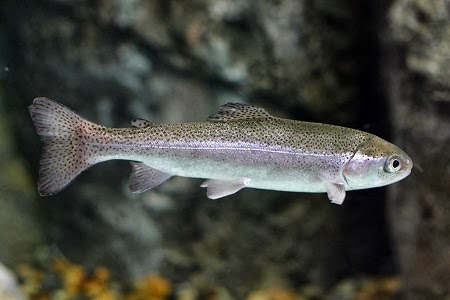
Rainbow trout
Rainbow trout
 Musashitomiyo : Musashi ninespine stickleback
It is a small fish and endangered species.
Musashitomiyo
 Japanese sea perch
Japanese sea perch
Cherry bass
Cherry bass
Fox-face
Fox-face
 Orange anemone fish
Orange anemone fish
Orangestrip prawn goby
White Socks
White Socks
Shrimp Fish
Shrimp Fish
Purple blotch basslet
Bluestreak fusilier
Bluestreak fusilier
Triggerfish
Triggerfish
Redtooth triggerfish
 
 Archer fish 
(鉄砲魚)
Archer fish
 
Ornate cowfish
Ornate cowfish
 Old wife
Old wife
Elephant-Nose Fish
Elephant-Nose Fish
 Arapaima
Arapaima
Leaf Fish
Leaf Fish
Natterer's Piranha
Natterer's Piranha
 
Dolphins show us fine performance.
Dolphin
Dolphins eat Japanese fish.
Dolphin
 
 Magellanic Penguin
Magellanic Penguin
 
Swallowtail butterfly
swallowtail butterfly
I saw many butterflies in Tokyo this year and I couldn’t see any deformity or abnormality.


2 and half years have passed since Fukushima Daiichi nuclear power plant accident. I have visited various places of Japan to see the health consequence of the accident.

Fortunately I have never found any impacts by the accident among Japanese creatures. As far as I know, nobody has health problem which is caused by the accident in Japan.
 
Our Prime Minister Abe assures that "the situation is under control" and "there will never be health problems."  He also said that "Tokyo is 250 kilometers away from Fukushima, and the kind of danger that you imagine does not exist in Tokyo. Tokyo is a very safe city."
 
As Tokyo is very far away from Fukushima, people in Tokyo have no concern about the nuclear power plant accident. People in Tokyo have already forgotten the accident, because it is very far away from the site and radioactive materials cannot reach there.

 
We know there is no problem for child birth and child rearing in Tokyo. So people in Tokyo are living without any concern about the accident.

I continue to visit various places in Japan to see the effects of the accident, because I can meet various creatures which are more sensitive to radioactive materials from the environment. It is important to see their health for our safety.


Public Health Network in Japan
公衆衛生ネットワーク
Public Health Network in Japan